|  | 
  
All the sheet music will be shipped within 2-5 business days.
GOSTRINGS offers a "DELIVERY CONFIRMATION" service for $3.00 for shipping within the USA. It provides date and time of delivery/attempted delivery upon inquiry. Click on it on the left banner.
All items on this page are NOT eligible for free shipping (only strings are eligible).
|
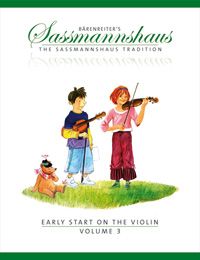
 | Early start on the Violin/Cello Vol. 1-4 Additional information on this title:
Preface,
Note Values And Symbols,
Open Strings,
String Crossing
The 'Cuckoo's Third' With The Second Finger,
The Fourth Finger,
The Triad,
The First Finger
String Crossing And Fingering On Different Strings,
The Third Finger,
Accidentals,
Scales On Two Strings,
More Exercises, Songs And Stroke Patterns,
New Stroke Patterns,
Slurred Notes,
Description:
In contrast to other beginner violin methods, The Sassmannshaus Tradition progresses swiftly by introducing advanced violin techniques in rudimentary form, such as shifting and varied bow strokes. Note reading is emphasized from the first lesson � children are brought up to become proficient sight-readers and play in chamber music ensembles as early as possible.
The child-friendly and age-appropriate text underlying the music enables children to perceive melodies as a whole and to understand their singable qualities. Songs and scales in different positions are easily explained and mastered within the first year. This is an important advantage over methods that confine children to the first position for many years.
The method is suitable for single instruction as well as for group and class lessons and each volume contains comprehensive material and carefully calibrated learning curves. They keep children curious and interested for many months and years.
Note reading is introduced from the beginning, and accidentals are explained in the easiest way in this first volume. By the end, many English children�s songs - using all fingers - have been played and note values from whole to eighth notes have been introduced. Even the easiest exercises are underlaid with text so that melodies can be perceived as a whole.
The Portato Stroke.
The second volume presents classical violin duets. The child�s knowledge and technique is expanded by dotted rhythms, sixteenths notes, and first double stops. And here is the most revolutionary aspect of the method: different finger patterns can be connected and combined to create any major and minor scale without the use of open strings. This creates the ability to practice scales in any position, often within the first year of playing! With this skill, songs learned in first position are easily transposed to other keys and higher position. Coupled with beginning shifting exercises this sets a foundation for an early virtuoso technique not available in any other method.
The third volume in this terrific tutor series emphasizes duet playing in a great variety of keys and rhythms and musical styles. Different finger patterns and strokes are thoroughly practiced.
The fourth volume introduces various positions as well as new bowing techniques. These are practiced in increasingly demanding classical duets. From here students can embark on the journey of standard repertoire �Concerti such as Vivaldi, Accolay etc. are now within reach.

|  |  | Christmas Repertoire Book for string strings (quartet) Christmas repertoire book for strings
11 instrumental movements by classical composers and 16 song settings by Christoph Jähne, solo or group scoring.
BA 9699
* Lasst uns froh und munter sein
* Kling Glöckchen
* Menuett (Georg Friedrich Händel)
* Schneeflöckchen
* Festlicher Marsch (Georg Friedrich Händel)
* Bourrée (Georg Friedrich Händel)
* Macht hoch die Tür
* Menuett (Jean Baptiste Lully)
* Leise rieselt der Schnee
* Sarabanda (Johann Melchior Caesar)
* Vom Himmel hoch
* Menuett (Georg Friedrich Händel)
* Stille Nacht
* Gavotte (Johann Fischer)
* O freudenreicher Tag (Sammlung Ditfurth)
* Bourrée (Johann Melchior Caesar)
* Lasst uns das Kindelein wiegen (Sammlung Ditfurth)
* Alle Jahre wieder
* Ihr Kindelein kommet
* O du fröhliche
* Menuett (Johann Fischer)
* Kommet, ihr Hirten
* Was soll das bedeuten
* Ich steh an deiner Krippen hier (Johann Sebastian Bach)
* Schlaf, mein Kindelein

|  |  | Vivaldi Violin Concerto in A minor, op.3/6 »Bärenreiter‘s Easy Concertos« for young violinists
Bärenreiter’s Easy Concertos is a new series of the most popular short concertos for violinists who want to begin performing in public. The series begins with works by the composers Rieding, Seitz and Vivaldi which are clear favourites amongst the first solo concertos played. The editions include a solo violin part and a piano reduction for the accompanist.
The series is edited by Kurt Sassmannshaus, the internationallyrenowned violin teacher and co-author of the Sassmannshaus violin school tradition. His forewords introduce these little gems and include tips to ensure successful first concerts. These volumes form an ideal continuation of the Sassmannshaus school editions and can be used in parallel from volume three onwards: They can also be used to supplement any violin method. This series will be continued and will introduce students to more demanding repertoire with an increasing level of difficulty.

|  |  | Rieding Violin Concerto in B minor, op. 35 »Bärenreiter‘s Easy Concertos« for young violinists
Bärenreiter’s Easy Concertos is a new series of the most popular short concertos for violinists who want to begin performing in public. The series begins with works by the composers Rieding, Seitz and Vivaldi which are clear favourites amongst the first solo concertos played. The editions include a solo violin part and a piano reduction for the accompanist.
The series is edited by Kurt Sassmannshaus, the internationallyrenowned violin teacher and co-author of the Sassmannshaus violin school tradition. His forewords introduce these little gems and include tips to ensure successful first concerts. These volumes form an ideal continuation of the Sassmannshaus school editions and can be used in parallel from volume three onwards: They can also be used to supplement any violin method. This series will be continued and will introduce students to more demanding repertoire with an increasing level of difficulty.

|  |  | Seitz Violin Concerto No. 2 in G major op. 13 »Bärenreiter‘s Easy Concertos« for young violinists
Bärenreiter’s Easy Concertos is a new series of the most popular short concertos for violinists who want to begin performing in public. The series begins with works by the composers Rieding, Seitz and Vivaldi which are clear favourites amongst the first solo concertos played. The editions include a solo violin part and a piano reduction for the accompanist.
The series is edited by Kurt Sassmannshaus, the internationallyrenowned violin teacher and co-author of the Sassmannshaus violin school tradition. His forewords introduce these little gems and include tips to ensure successful first concerts. These volumes form an ideal continuation of the Sassmannshaus school editions and can be used in parallel from volume three onwards: They can also be used to supplement any violin method. This series will be continued and will introduce students to more demanding repertoire with an increasing level of difficulty.

|  |
|